
Cfm Duct Chart
Duct size limits how much air reaches a room. This chart shows the airflow (CFM) that common round duct sizes carry at the friction rates used in residential design, with velocities and rectangular equivalents — and the calculator sizes a duct for any airflow you need.
- Free to use
- No sign-up
- Runs in your browser
Duct size and CFM calculator
CFM of an existing duct
Duct Sizing Reference Pack
Printable round duct CFM chart at five friction rates, rectangular equivalents table, an Excel duct sizing calculator and a room-by-room airflow worksheet.
- CFM chart (PDF/XLSX)
- Rectangular equivalents (PDF)
- Sizing calculator (XLSX)
- Airflow worksheet (PDF/DOCX/XLSX)
Formats: PDF, XLSX, DOCX. Instant download after payment (link valid 72 hours, up to 5 downloads). AI-assisted: the templates were drafted with AI help and reviewed and laid out before publishing.
$3.00 USD, one-time 4 files · about $0.75 each
- Instant download
- 7-day refund
- Secure checkout by Stripe
7-day money-back guarantee. Full refund within 7 days of purchase, even after you download.
Free sample: Duct Sizing Calculator (PDF, 62 KB)
Full refund within 7 days — see the refund policy and license.
Free printables
Single sheets you can print right now, no sign-up. The full pack adds every sheet in one download plus the editable files.
 Printable CFM Duct Chart Worksheet
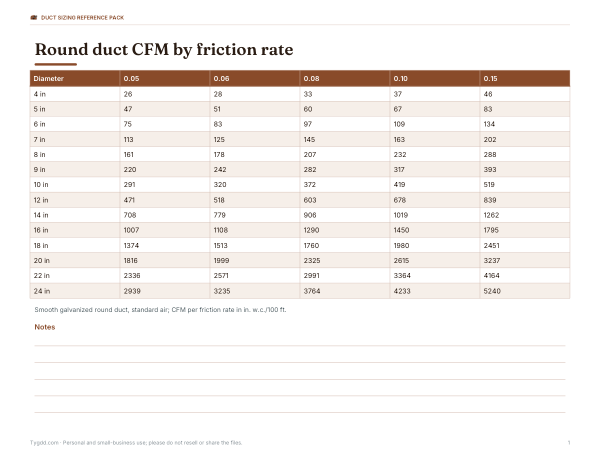
Round duct CFM chart
| Diameter | CFM @ 0.05 | CFM @ 0.08 | CFM @ 0.10 | Velocity @ 0.10 (ft/min) |
|---|---|---|---|---|
| 4 in | 26 | 33 | 37 | 426 |
| 5 in | 47 | 60 | 67 | 492 |
| 6 in | 75 | 97 | 109 | 553 |
| 7 in | 113 | 145 | 163 | 611 |
| 8 in | 161 | 207 | 232 | 666 |
| 9 in | 220 | 282 | 317 | 718 |
| 10 in | 291 | 372 | 419 | 768 |
| 12 in | 471 | 603 | 678 | 863 |
| 14 in | 708 | 906 | 1019 | 953 |
| 16 in | 1007 | 1290 | 1450 | 1039 |
| 18 in | 1374 | 1760 | 1980 | 1120 |
| 20 in | 1816 | 2325 | 2615 | 1199 |
Friction rates are in inches of water column per 100 feet of straight duct. Values are calculated for smooth galvanized steel round duct at standard air density using the empirical friction relation Δp ≈ 0.109 × CFM^1.9 ÷ D^5.02 — they agree closely with common duct calculators (ductulators).
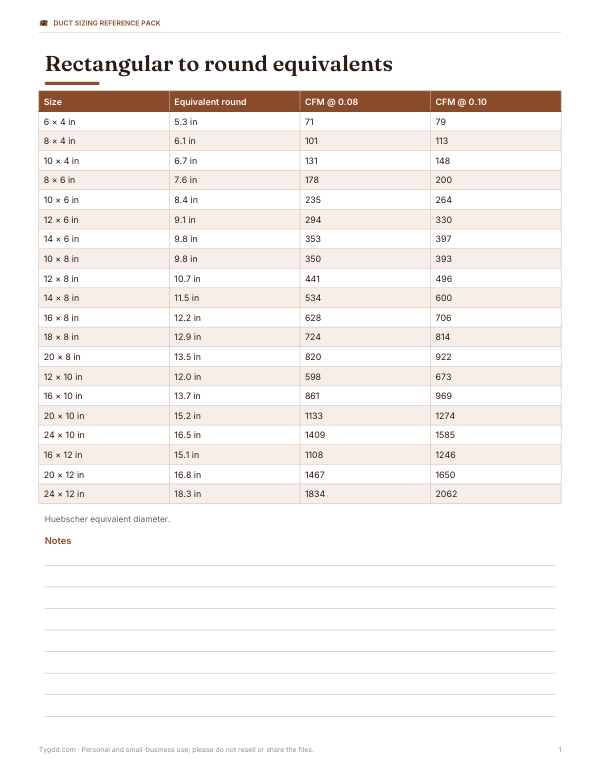
Rectangular duct equivalents
| Rectangular size | Equivalent round | CFM @ 0.10 |
|---|---|---|
| 8 × 6 in | 7.6 in | 200 |
| 10 × 6 in | 8.4 in | 264 |
| 12 × 6 in | 9.1 in | 330 |
| 10 × 8 in | 9.8 in | 393 |
| 12 × 8 in | 10.7 in | 496 |
| 14 × 8 in | 11.5 in | 600 |
| 16 × 8 in | 12.2 in | 706 |
| 20 × 8 in | 13.5 in | 922 |
| 14 × 10 in | 12.9 in | 819 |
| 20 × 10 in | 15.2 in | 1274 |
| 24 × 10 in | 16.5 in | 1585 |
Equivalent diameter uses the Huebscher formula, De = 1.30 (a·b)^0.625 ÷ (a + b)^0.25, which gives the round duct with the same friction loss and airflow. Flat, wide ducts carry less air than their area suggests because more of the air is close to the walls.
Worked example
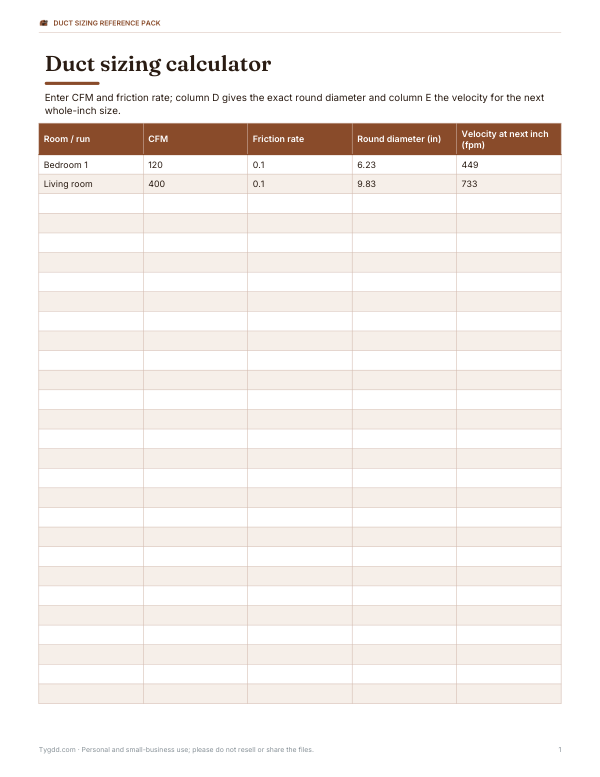
A bedroom needs 120 CFM and a living room 400 CFM, with a design friction rate of 0.1. The calculator gives an exact diameter of 6.23 in for the bedroom — so a 6-inch run, which carries about 109 CFM — and 9.83 in for the living room, so a 10-inch duct (about 419 CFM) at roughly 733 ft/min. If the ceiling space only allows an 8-inch-high trunk, the equivalent rectangular size is about 11 × 8 in.
Choosing a friction rate
The friction rate is the pressure loss allowed per 100 ft of duct. In residential design it comes from the blower’s available static pressure after filters, coils, registers and fittings are accounted for, divided by the total effective length of the longest run including fitting equivalent lengths. Many simple systems end up between about 0.06 and 0.1 in. w.c./100 ft. Lower friction rates mean bigger, quieter ducts; higher rates allow smaller ducts but need more fan pressure.
Velocity and noise
| Duct section | Typical maximum velocity (residential) |
|---|---|
| Main supply trunk | about 700–900 ft/min |
| Branch runs | about 500–600 ft/min |
| Return ducts | about 500–700 ft/min |
| Supply registers / grilles | check the manufacturer’s noise ratings |
These are common rules of thumb for quiet residential systems; design guides and equipment manufacturers give specific limits.
Typical room airflow
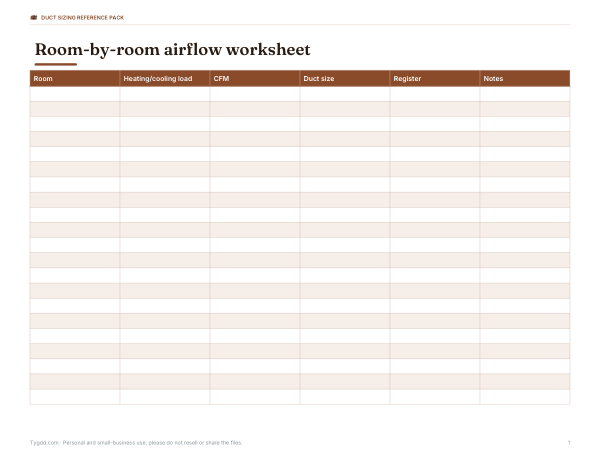
Room airflow comes from a heating and cooling load calculation (such as Manual J), not from floor area alone. As a very rough cross-check, many cooling systems move around 350–450 CFM per ton of capacity, and the total is shared between rooms in proportion to each room’s load. A small bedroom might need 50–120 CFM and a large open living area several hundred. Use the calculator to turn each room’s CFM into a duct size, then check that the trunk carries the sum of its branches.
Sizing trunks and branches
- List every supply run with its CFM.
- Size each branch with the calculator at your design friction rate.
- Add up the CFM of all branches fed by each trunk section.
- Size each trunk section for its total, reducing the trunk as branches leave it.
- Check velocities, especially near registers and in the main trunk.
- Size returns for the full system airflow at a low friction rate to keep them quiet.
Flexible duct
Flexible duct has a rougher, corrugated lining and loses more pressure than smooth metal duct of the same diameter — and much more if it is compressed, sagging or kinked. Many designers pick a larger flex size than the metal-duct chart suggests, keep runs as short and straight as possible and support them properly. The manufacturer’s friction data should be used for a formal design.
Privacy
All calculations run in your browser.
Frequently asked questions
How many CFM does a 6-inch duct carry?
About 109 CFM at 0.1 in. w.c./100 ft, less at lower friction rates.
How many CFM does an 8-inch duct carry?
About 232 CFM at 0.1 in. w.c./100 ft.
What friction rate should I use?
It depends on the blower and duct layout; many residential designs fall between 0.06 and 0.1.
How do I convert rectangular duct to round?
Use the equivalent diameter formula De = 1.30 (ab)^0.625 ÷ (a + b)^0.25.
Does flex duct carry the same CFM?
No — it usually carries less at the same size, especially if not stretched tight.
Is this a full duct design?
No. Use Manual D or a professional designer for a complete system.
What does in. w.c. mean?
Inches of water column — a unit of pressure; 1 in. w.c. is about 249 pascals.
Why is velocity important?
High velocity makes ducts and registers noisy; low velocity can mean poor air throw.